Types of Kitchen Knives and Their Uses: The Complete Guide
Types of kitchen knives and their uses: the 3 every cook needs, 7 specialty knives and when they're worth it, plus blade lengths, steel and simple knife care.
PulseCrafted Kitchen is reader-supported: when you buy through links on this page, we may earn a commission at no cost to you. As an Amazon Associate I earn from qualifying purchases. How we make money
On this page
- Types of kitchen knives at a glance
- The 3 knives every kitchen needs
- Specialty kitchen knives and their uses
- Which types of kitchen knives do you need?
- Our picks: 5 kitchen knives for a starter set
- How to choose kitchen knives
- The parts of kitchen knives
- How to care for kitchen knives
- Mistakes to avoid with kitchen knives
- Our guides in this category
- FAQ
Most kitchens need only three knives: an 8-inch chef’s knife, a small paring knife and a serrated bread knife. Those three cover chopping, peeling and slicing bread and tomatoes, which is nearly everything a home cook does. The other types of kitchen knives are specialists. A boning knife, a carving knife or a cleaver earns its place only if you do that job often.
This guide explains all ten common types, what each one is for and what it’s bad at. It’s the hub for everything we write about knives, so start here before you buy a set.
How we put this together: we compared blade shapes, lengths and steels across the major knife makers. We also used the knife tests from America’s Test Kitchen, and the five knives we suggest below are the ones it recommends. We haven’t tested them ourselves. (More on how we choose what to recommend.)
Types of kitchen knives at a glance
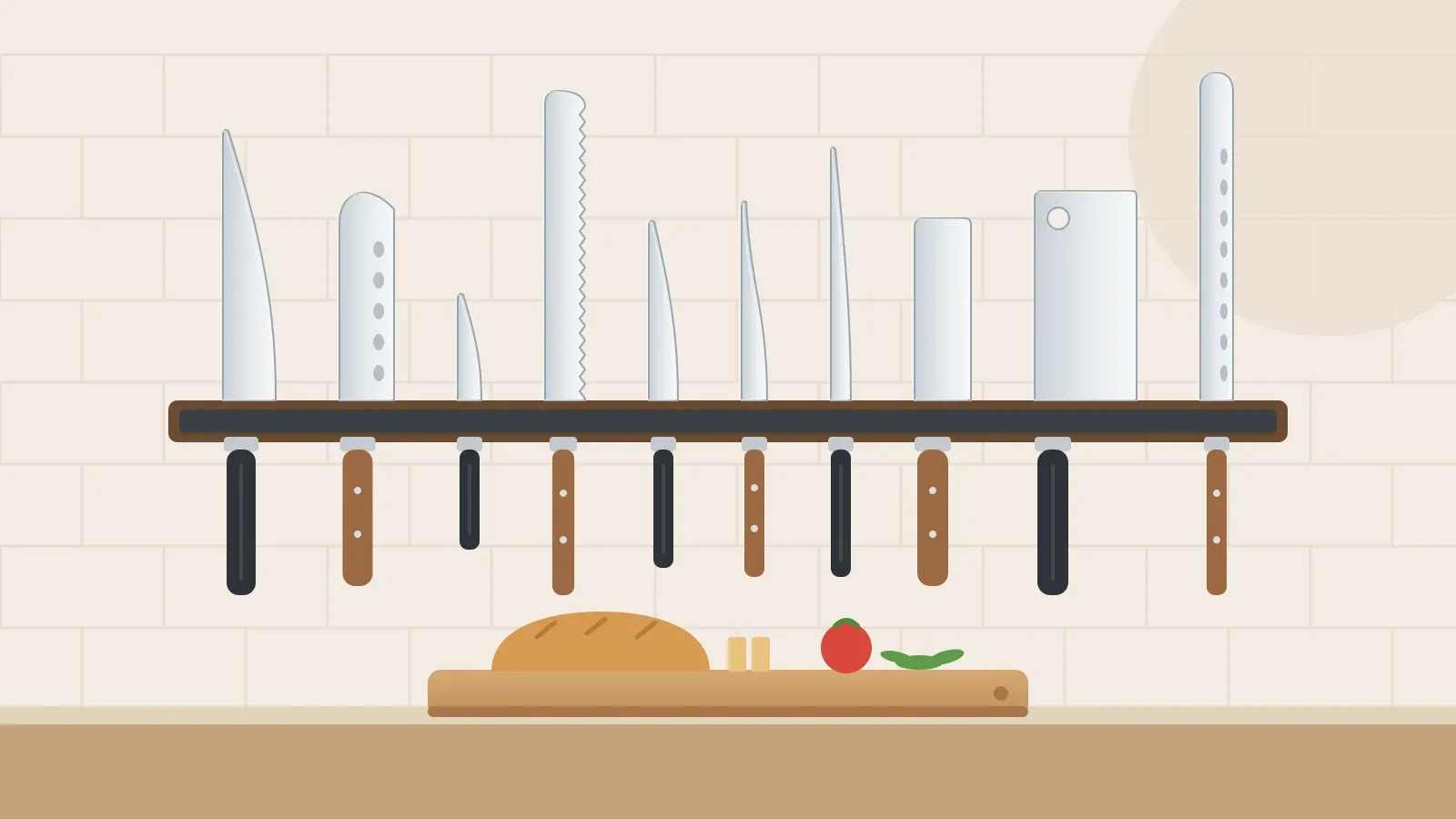
Here are the ten types of kitchen knives and their uses side by side, with the job each one does best.
| Knife | Typical blade | Best for | Not for |
|---|---|---|---|
| Chef’s knife | 8 in (6 to 10 in) | Chopping, slicing, dicing, mincing | Peeling, bread |
| Santoku | 5 to 7 in | Thin slices, chopping vegetables | Rocking cuts, bones |
| Paring knife | 3 to 4 in | Peeling, coring, trimming | Big vegetables |
| Bread knife | 8 to 10 in, serrated | Crusty bread, tomatoes, cake | Fine chopping |
| Utility knife | 4 to 7 in | Sandwiches, small produce, cheese | Heavy chopping |
| Boning knife | 5 to 6 in | Taking meat off the bone, trimming | Vegetables |
| Fillet knife | 6 to 9 in, flexible | Filleting and skinning fish | Thick meat, bones |
| Nakiri | 6 to 7 in | Push-cutting vegetables | Meat, bones |
| Cleaver | 6 to 8 in, heavy | Chopping through bones and joints | Fine work |
| Carving knife | 10 to 14 in | Slicing roasts, turkey and ham | Small jobs |
The 3 knives every kitchen needs
Start with these three. Together they handle almost every recipe, and they cost less than most knife block sets.
1. Chef’s knife
An 8-inch chef’s knife handles most of the cutting in any kitchen. The curved edge lets you rock the blade to mince herbs and garlic, and the wide blade scoops food off the board. Use it to chop onions, slice meat, dice potatoes and cut through squash. An 8-inch blade suits most cooks. Go shorter if you have small hands or a tiny counter, and longer only if you often cut big batches.
2. Paring knife
A paring knife is a small 3- to 4-inch blade for jobs that need control. Peel apples, hull strawberries, core tomatoes, devein shrimp and trim green beans with it. Most of that work happens in your hand, not on the board. A big chef’s knife is clumsy here, which is why most cooks keep a paring knife close by.
3. Serrated bread knife
A serrated bread knife has a long, saw-like edge that cuts through crust without crushing the soft inside. It’s also the best knife for ripe tomatoes, peaches, sandwiches and layer cakes. A 10-inch blade fits a whole loaf of sourdough. Serrated edges stay sharp a long time, but they’re hard to sharpen at home, so most people simply replace the knife after several years.
Specialty kitchen knives and their uses
These seven knives make certain jobs faster or neater. None of them is essential, so add one only when you notice you need it.
4. Santoku
A santoku is a Japanese all-purpose knife with a flatter edge and a rounded tip. It’s usually 5 to 7 inches long and lighter than a chef’s knife. Instead of rocking, you chop straight down or slice forward, which makes very thin slices of vegetables and fish. Many santokus have dimples along the blade, called a Granton edge, so slices stick less. It’s a good choice if a chef’s knife feels too big.
5. Utility knife
A utility knife sits between a paring knife and a chef’s knife, with a 4- to 7-inch blade. It’s handy for slicing a sandwich, a block of cheese, a lemon or a shallot on the board. Some have serrated edges for tomatoes and bagels. If you already own a chef’s knife and a paring knife, you can live without one.
6. Boning knife
A boning knife has a narrow 5- to 6-inch blade that slips between meat and bone. Use it to bone chicken thighs, take a pork loin off the rib, or trim fat and silver skin. Flexible blades follow the curves of poultry and fish. Stiffer blades are better for beef and pork.
7. Fillet knife
A fillet knife is long, thin and very flexible, so it bends along a fish’s backbone. It’s the tool for filleting whole fish and sliding the skin off a fillet. If you rarely buy whole fish, a flexible boning knife does the job well enough.
8. Nakiri
A nakiri is a Japanese vegetable knife with a straight, rectangular blade. Its flat edge meets the board along its whole length, so it cuts all the way through carrots, cabbage and herbs in one push. It’s lovely for vegetable-heavy cooking. Keep it away from bones and frozen food, because the thin edge can chip.
9. Cleaver
A meat cleaver has a heavy, rectangular blade built to chop through bones and joints. Use it to split chicken, cut spare ribs or break down a whole duck. Don’t confuse it with a Chinese cleaver: that one looks similar but is thin and made for vegetables, not bones.
10. Carving knife
A carving knife, also called a slicing knife, has a long, narrow blade of 10 to 14 inches. The length lets you cut a roast, a turkey breast, a ham or a brisket in one smooth stroke, so slices stay neat. Granton dimples help thin slices fall away from the blade. Most people use one only a few times a year, so it can live in a drawer.
Which types of kitchen knives do you need?
Your cooking decides which knives earn a place in the drawer. Start from the three essentials, then add the one that fits how you cook.
- New cooks: a chef’s knife, a paring knife and a bread knife. Nothing else until you miss something.
- Meat lovers: add a boning knife for chicken and pork, and a carving knife if you roast often.
- Fish cooks: add a flexible boning or fillet knife.
- Vegetable-heavy cooks: a santoku or a nakiri makes fast, thin slices, but it’s a second knife, not a replacement for the chef’s knife.
- Bakers: the bread knife matters most, and a long serrated blade also levels cake layers.
- Small kitchens: three knives on a magnetic strip free a whole drawer. Our guide to organizing a small kitchen without a pantry shows how to use that wall space.
Our picks: 5 kitchen knives for a starter set
These five knives match the starter set America’s Test Kitchen recommends after its tests: three essentials and two useful extras. Buy the first three now and the others when you need them. We earn a commission if you buy through these links, at no cost to you (affiliate disclosure).
- Best chef’s knifeVictorinox Fibrox Pro 8-Inch Chef’s KnifeCheck price
- Best paring knifeVictorinox 3.25-Inch Spear Point Paring KnifeCheck price
- Best bread knifeMercer Culinary Millennia 10-Inch Wide Wavy Edge Bread KnifeCheck price
- Best boning knifeVictorinox Fibrox 6-Inch Flexible Boning KnifeCheck price
- Best carving knifeVictorinox Fibrox Pro 12-Inch Granton Slicing KnifeCheck price
| Start here | Essential | Essential | Extra | Extra | |
| Product | Victorinox Chef’s Knife | Victorinox Paring Knife | Mercer Bread Knife | Victorinox Boning Knife | Victorinox Slicing Knife |
| Best for | Everyday chopping and slicing | Peeling, coring, trimming | Bread, tomatoes, cake | Boning chicken, trimming meat | Roasts, turkey, ham |
| Blade | 8 in, plain edge | 3.25 in, spear point | 10 in, wavy serrated | 6 in, flexible | 12 in, Granton edge |
| Steel | Stainless steel | Stainless steel | High-carbon Japanese steel | Stainless steel | High-carbon stainless steel |
| Handle | Non-slip Fibrox Pro | Polypropylene | Textured, non-slip | Non-slip rubber | Non-slip Fibrox Pro |
| Care | Hand-wash keeps it sharp | Hand-wash keeps it sharp | Hand-wash only | Hand-wash keeps it sharp | Hand-wash keeps it sharp |
| Buy | Check price on Amazon | Check price on Amazon | Check price on Amazon | Check price on Amazon | Check price on Amazon |
Victorinox Fibrox Pro 8-Inch Chef’s Knife
Best for: Anyone buying their first good knife
If you buy one knife, make it this one. It’s the chef’s knife America’s Test Kitchen keeps recommending for its sharp, light blade and comfortable grip. It chops onions, slices chicken and minces herbs equally well. The handle won’t win design awards, but it stays secure when your hands are wet.
What we like
- Light, sharp blade that handles almost every cutting job
- Non-slip handle that stays secure when wet
- Swiss made, with a lifetime warranty against defects
- Weighted and balanced for easy handling
Watch out for
- The plastic-feeling handle looks plain next to wood or steel
- Thinner, lighter blade than heavy German knives
- Needs regular honing to stay at its best
- Blade
- 8 in, stainless steel
- Edge
- Plain, tapered
- Handle
- Fibrox Pro (TPE)
Victorinox 3.25-Inch Spear Point Paring Knife
Best for: Peeling, coring and other small jobs in your hand
A paring knife does the fiddly jobs a chef’s knife can’t, like hulling strawberries or coring a tomato. This one has the larger handle of Victorinox’s paring knives, which helps if you find tiny handles hard to grip. Keep it next to the cutting board, because you’ll reach for it often.
What we like
- Short, sharp blade for precise work
- Large handle that is easy to hold
- Light and nimble
- Lifetime warranty against defects
Watch out for
- Too small for big vegetables
- Thin blade, so not for prying or twisting
- Simple polypropylene handle
- Blade
- 3.25 in, stainless steel
- Edge
- Straight, spear point
- Handle
- Polypropylene
Mercer Culinary Millennia 10-Inch Wide Wavy Edge Bread Knife
Best for: Crusty loaves, ripe tomatoes and layer cakes
This is the bread knife America’s Test Kitchen rates highest. The wide wavy edge cuts sourdough and bagels cleanly, and it slices tomatoes without squashing them. Wash it by hand and dry it right away, as Mercer advises. Serrated edges stay sharp for years with that care.
What we like
- Wavy teeth bite through crust without crushing the crumb
- 10-inch blade spans a full loaf
- Textured, non-slip handle
- One-piece high-carbon Japanese steel
Watch out for
- Hand-wash only
- Long blade needs a long drawer or a knife strip
- The chunky handle looks utilitarian
- Blade
- 10 in, wavy serrated
- Steel
- High-carbon Japanese steel
- Handle
- Textured, non-slip
Victorinox Fibrox 6-Inch Flexible Boning Knife
Best for: Boning chicken, trimming meat and filleting the odd fish
Buying whole chickens or bone-in cuts saves money, and a boning knife makes the job quick. The flexible blade bends around joints and slides under silver skin. If you cook fish too, it can stand in for a fillet knife, so you don’t need both.
What we like
- Narrow, flexible blade follows bones closely
- Doubles as a fillet knife for small fish
- Non-slip handle
- Swiss made
Watch out for
- Too flexible for big cuts of beef
- Only worth it if you break down meat often
- Plain handle
- Blade
- 6 in, flexible, stainless steel
- Edge
- Plain
- Handle
- Non-slip rubber
Victorinox Fibrox Pro 12-Inch Granton Slicing Knife
Best for: Holiday roasts, turkey, ham and brisket
A chef’s knife can carve, but its short blade saws back and forth and tears the meat. This long slicer makes even, thin slices in one pull, which matters for a turkey or a brisket. Store it in a sheath or on a magnetic strip, since the long edge is easy to damage in a drawer.
What we like
- 12-inch blade slices a roast in one stroke
- Granton dimples help slices fall away
- Round tip and non-slip handle
- Meets NSF food-safety standards
Watch out for
- Long, so it needs safe storage
- Most homes use it only a few times a year
- Not for boning or carving around joints
- Blade
- 12 in, Granton edge
- Steel
- High-carbon stainless steel
- Handle
- Fibrox Pro
How to choose kitchen knives
All types of kitchen knives come down to the same five choices. The right knife is the one that feels comfortable and stays sharp.
Blade length
Longer blades cut bigger food in fewer strokes but are harder to control. For a chef’s knife, 8 inches suits most people, and 6 or 7 inches suits small hands and small kitchens.
Steel
Stainless steel resists rust and stains, so it’s easy to live with. High-carbon stainless steel holds an edge a little longer. Pure carbon steel gets very sharp but rusts and darkens unless you dry it right away. Ceramic blades stay sharp a long time but can chip or snap if dropped.
Forged or stamped
Forged knives are hammered from one piece of steel, so they’re heavier and often have a thick bolster where the blade meets the handle. Stamped knives are cut from a sheet of steel, so they’re lighter and usually cheaper. Both can be excellent: all five of our picks are stamped.
Western or Japanese edge
Western (German-style) knives have thicker blades and a wider edge angle, so they’re sturdy and forgiving. Japanese knives are usually thinner, harder and sharper, but the fine edge can chip on bones or frozen food. Our German vs Japanese knives guide compares the two styles in detail.
Handle and weight
Hold a knife before you buy it if you can. Your hand shouldn’t touch the board when you chop, and the handle should feel secure when wet. Heavy knives power through squash, while light knives are less tiring for long prep.
The parts of kitchen knives
Most types of kitchen knives share the same parts, and knowing them makes product descriptions easier to read.
- Tip and point: the front of the blade, for fine work and piercing.
- Edge: the sharpened part, either plain or serrated.
- Spine: the thick, unsharpened top of the blade.
- Heel: the back of the edge, used for heavy chopping.
- Bolster: the thick collar between blade and handle on forged knives.
- Tang: the part of the blade that runs into the handle. A full tang runs the whole length.
How to care for kitchen knives
A sharp knife is safer than a dull one, because it cuts where you aim instead of slipping. These habits keep all types of kitchen knives working.
- Hone often. A honing steel straightens the edge between sharpenings. A few strokes before you cook is enough.
- Sharpen when honing stops helping. For most home cooks, that’s a few times a year. Serrated knives rarely need it.
- Wash by hand and dry right away. Dishwashers knock blades against other things and dull the edge.
- Store knives safely. Use a block, a magnetic strip or blade guards, not a loose drawer. Our small kitchen organization ideas show where a magnetic strip fits.
- Cut on wood or plastic. Glass, stone and ceramic boards dull an edge fast. Food safety experts, including the USDA, recommend one board for raw meat and another for produce and bread, as this University of California summary explains.
Mistakes to avoid with kitchen knives
- Buying a big block set. Most sets include knives you’ll never use. Three good knives beat twelve average ones.
- Using the chef’s knife for everything. Peeling with it is awkward, and bread crushes under it.
- Prying and twisting. Opening cans or cutting bones with a thin blade chips the edge.
- Scraping food off the board with the edge. Flip the knife and use the spine instead.
- Putting good knives in the dishwasher. Hand-washing takes a minute and protects the edge.
Our guides in this category
Published guides in this category appear here automatically. You can also browse every guide in the Knives category.
- The Best Cutting Boards for Raw Meat (Plastic, Rubber and Composite)Best picks
The best cutting board for raw meat is non-porous and fits your dishwasher. 6 picks compared (plastic, rubber, composite), plus USDA cleaning steps.
- German vs Japanese Knives: Which Should You Buy?Comparison
German vs Japanese knives compared on steel, sharpness, weight, care and price, plus which kitchen knife style suits how you cook and our picks for each.
- Wood vs Plastic Cutting Boards: Which Is Better?Comparison
Wood vs plastic cutting board compared on bacteria, knife edges, microplastics, cleaning and lifespan, plus which to use for raw meat and our picks for each.
FAQ
What are the 3 most important kitchen knives?
A chef’s knife, a paring knife and a serrated bread knife. The chef’s knife does most cutting, the paring knife handles small jobs in your hand, and the bread knife slices crusty bread and tomatoes.
Which kitchen knives are best for cutting meat?
For raw meat, a chef’s knife handles most jobs, and a boning knife is best for taking meat off the bone. For cooked roasts, a long carving knife gives neat slices. You need a cleaver only for chopping through bones.
What is the difference between a chef’s knife and a santoku?
A chef’s knife has a curved edge and a pointed tip, so you can rock it to mince. A santoku has a flatter edge and a rounded tip, so you chop straight down or slice forward. Santokus are usually shorter and lighter.
Do I need a whole set of kitchen knives?
No. Most home cooks use three knives for nearly everything. Buying those separately usually gets you better knives for the money than a large block set.
What is a utility knife used for?
A utility knife is a mid-size knife for small jobs on the board, like slicing sandwiches, cheese, citrus and shallots. It’s handy but optional if you own a chef’s knife and a paring knife.
How often should kitchen knives be sharpened?
Hone them every time or two you cook, and sharpen them when honing no longer restores the edge. For most home cooks, that means sharpening a few times a year.