The Best Cutting Boards for Raw Meat (Plastic, Rubber and Composite)
The best cutting board for raw meat is non-porous and fits your dishwasher. 6 picks compared (plastic, rubber, composite), plus USDA cleaning steps.
PulseCrafted Kitchen is reader-supported: when you buy through links on this page, we may earn a commission at no cost to you. As an Amazon Associate I earn from qualifying purchases. How we make money
On this page
- Our quick picks
- The 6 cutting boards for raw meat compared
- Our picks, reviewed
- Also considered
- How to choose a cutting board for raw meat
- How to clean a raw meat cutting board, step by step
- Wood vs plastic cutting boards for raw meat: what the research says
- Where to keep a raw meat board in a small kitchen
- FAQ
The best cutting board for raw meat is a plastic one that you keep only for meat and can wash hot after every use. For most kitchens, that’s the OXO Good Grips Plastic Utility Cutting Board. It doesn’t absorb juices, it has a groove to catch drips, and at about 15 by 10 inches it’s small enough to fit in many dishwashers.
Raw chicken, beef, pork and fish carry bacteria that you don’t want anywhere near a salad. So the board you use for them needs a different set of strengths from your everyday wooden board. It should be easy to sanitize, cheap enough to replace when it gets scarred, and the right size for what you cut. This guide covers six boards in three materials, plus the cleaning routine that matters more than any brand.
How we chose: we haven’t tested these boards in our own kitchen. Instead, we read the makers’ listings for size, weight, material and care, then checked them against independent tests from Cook’s Illustrated, Reviewed and Tasting Table. The food safety advice comes from USDA guidance as published by university extension services. (More on how we choose what to recommend.)
Our quick picks
- Best overallOXO Good Grips Plastic Utility Cutting BoardCheck price
- Best for whole chickens and roastsOXO Good Grips Plastic Carving & Cutting BoardCheck price
- Best juice trenchKitchenAid Classic Plastic Cutting Board with Perimeter TrenchCheck price
- Best color-coded setJoseph Joseph Folio 4-Piece Color-Coded Cutting Board SetCheck price
- Best heat-resistant boardEpicurean Kitchen Series Cutting Board, 14.5 x 11.25 inCheck price
- Best for your knivesAsahi Cookin' Cut Rubber Cutting BoardCheck price
The 6 cutting boards for raw meat compared
| Best overall | Roasts | Trench | Color-coded | Heat-resistant | Knife care | |
| Product | OXO Utility | OXO Carving | KitchenAid Classic | Joseph Joseph Folio | Epicurean Kitchen | Asahi Cookin' Cut |
| Material | Plastic | Plastic | Plastic | Plastic boards, slim case | Paper composite (Richlite) | Synthetic rubber |
| Size | 14.75 x 10.4 in | 21 x 14.5 in | 18.1 x 12 in | 4 boards, 13 x 9 in | 14.5 x 11.25 in | 16.5 x 9.8 in |
| Thickness | 0.5 in | 0.7 in | 0.59 in | Thin boards | 0.25 in | 0.5 in |
| Weight | 1.53 lb | 3.3 lb | 2.71 lb | 5.07 lb with case | 1.6 lb | 3.3 lb |
| Catches juices | Drip groove | Deep juice grooves | Perimeter trench | No groove | No groove | No groove |
| Cleaning | Dishwasher safe | Dishwasher safe (check it fits) | Dishwasher safe per listing | Boards dishwasher safe | Dishwasher safe | Hand wash only |
| Best for | Everyday meat and chicken | Whole birds, roasts, brisket | Juicy cuts, burgers | Shared kitchens | Small kitchens, hot pans | Sharp knives, daily cooks |
| Buy | Check price on Amazon | Check price on Amazon | Check price on Amazon | Check price on Amazon | Check price on Amazon | Check price on Amazon |
Our picks, reviewed
OXO Good Grips Plastic Utility Cutting Board
Best for: Anyone who wants one board just for raw meat, poultry and fish
This is the board we’d buy first. It’s big enough to break down a pack of chicken thighs or slice a flank steak, yet small enough to stand in many dishwasher racks, and that’s the real reason it wins. A raw meat board only stays safe if cleaning it is easy, and this one goes straight from the counter into a hot cycle. Cook’s Illustrated calls it a longtime favorite small plastic board, and Reviewed named it the best plastic board it tested. Also, both sides work, so you can flip it when one face gets scratched.
What we like
- Non-porous, double-sided surface that resists odors
- Drip-catcher groove and easy-pour corners
- Non-slip feet keep it still while you trim chicken
- Light at 1.53 lb, so you will actually wash it every time
Watch out for
- Too small to carve a whole turkey
- Plastic scars with use, so plan to replace it every year or two
- The white surface shows stains from paprika and turmeric
- Size
- 14.75 x 10.4 x 0.5 in
- Weight
- 1.53 lb
- Care
- Dishwasher safe
OXO Good Grips Plastic Carving & Cutting Board
Best for: Spatchcocking chickens, trimming brisket and carving roasts
When you cut a whole chicken on a small board, legs and juices end up on the counter, and the counter is much harder to sanitize than the board. This big OXO gives you room to work, and its grooves hold the juices instead. Before you buy it, though, measure your sink and dishwasher. If it won’t fit in either, you’ll be scrubbing it in the bathtub, and that’s when people start skipping the wash.
What we like
- Large 21 x 14.5 in surface holds a whole bird
- Deep juice grooves keep drippings off the counter
- Tapered edges work as handles
- Non-slip feet and a dishwasher-safe, non-porous surface
Watch out for
- Too big for many dishwashers and small sinks, so measure first
- Takes real storage space in a small kitchen
- Heavier than the Utility board at 3.3 lb
- Size
- 21 x 14.5 x 0.7 in
- Weight
- 3.3 lb
- Care
- Dishwasher safe
KitchenAid Classic Plastic Cutting Board with Perimeter Trench
Best for: Juicy cuts, burgers and resting meat
A groove that runs all the way around the board matters more than it sounds. When you slice a steak that has rested, or press raw burger patties, the liquid runs off every side, not only the one with a groove. Tasting Table found that the trench held the liquid from all but the juiciest roasts, and that the board stayed put while its testers sliced raw meat. Check the care label on your board when it arrives, because the Amazon listing contradicts itself.
What we like
- A trench runs around the whole edge to collect liquid
- Non-slip edges keep it in place
- 12 x 18 in: roomy without being huge
- Tasting Table named it its best board for meat
Watch out for
- Heavier than the OXO Utility at 2.71 lb
- The listing is inconsistent on care: the title and bullets say dishwasher safe, the care field says hand wash
- One-sided trench design, so the back is a plain board
- Size
- 18.1 x 12 x 0.59 in
- Weight
- 2.71 lb
- Care
- Dishwasher safe per the listing
Joseph Joseph Folio 4-Piece Color-Coded Cutting Board Set
Best for: Shared kitchens where everyone needs to know which board is for raw meat
Rules about separate boards work only if everyone in the house follows them. A color system takes the guessing out. Give each color one job, for example raw meat, fish, vegetables and cooked food, and tape a note inside a cupboard door until the habit sticks. The case also solves a small-kitchen problem, because it keeps four boards in the footprint of one and holds them apart so they dry. The boards are fairly small, so pair the set with a bigger board for roasts.
What we like
- Four colors, so raw meat, fish, vegetables and cooked food each get their own board
- Boards go in the dishwasher
- Slim case stores them upright, apart, so they can dry
- Textured, knife-friendly surface with non-slip feet
Watch out for
- No juice grooves
- Boards are smallish at 13 x 9 in
- The surface is made to mark slightly as you cut, so it shows wear early
- Boards
- 4, each about 13 x 9 in
- Weight
- 5.07 lb with case
- Care
- Boards dishwasher safe
Epicurean Kitchen Series Cutting Board, 14.5 x 11.25 in
Best for: Small kitchens, and cooks who want one thin board that also works as a trivet
Epicurean boards look like wood but behave more like plastic. They don’t need oil, they go in the dishwasher, and they don’t soak up juices. That makes this one a good raw meat board for people who dislike the look of plastic. It’s thin enough to slide into a narrow gap next to the fridge, and you can set a hot pan on it afterward. The trade-off is hardness: it isn’t as kind to a sharp knife as plastic or rubber.
What we like
- Wood-fiber composite (Richlite) that goes in the dishwasher
- Heat resistant to 350°F, so it doubles as a trivet
- Only 0.25 in thick and 1.6 lb
- NSF approved, made in the USA, no oiling needed
Watch out for
- No juice groove
- Harder than plastic, so it is louder and less forgiving on knife edges
- Thin boards can slide: put a damp towel underneath
- Size
- 14.5 x 11.25 x 0.25 in
- Weight
- 1.6 lb
- Care
- Dishwasher safe
Asahi Cookin' Cut Rubber Cutting Board
Best for: Cooks with good knives who cut raw meat and fish every day
Rubber boards are common in professional Japanese kitchens, and once you’ve cut on one, plastic feels harsh. The surface closes up a little after each cut, so it scars more slowly than plastic, and when it does get stained you can sand it smooth again. The big catch for a raw meat board is cleaning: it can’t go in the dishwasher. If you choose it, wash it in hot, soapy water right after use and sanitize it with a bleach solution once a week.
What we like
- Synthetic rubber gives a little under the blade, so edges stay sharp longer
- Low water absorption, so it dries quickly
- You can sand off stains and scratches with waterproof sandpaper
- Made in Japan; heavy enough to stay put
Watch out for
- Hand wash only
- No juice groove
- 3.3 lb for a 16.5 x 9.8 in board
- Size
- 16.5 x 9.8 x 0.5 in
- Weight
- 3.3 lb
- Care
- Hand wash only
Also considered
- Wood boards like John Boos maple. USDA guidance allows wood or non-porous boards for raw meat, as long as you clean them well. Still, wood can’t go in the dishwasher and needs regular oiling. We keep a good wooden board for bread, vegetables and carving cooked meat instead.
- Bamboo. It’s harder and less porous than most hardwoods, so it resists knife scars. But that hardness also wears down knife edges, and bamboo shouldn’t go in the dishwasher.
- Glass, marble, stainless steel and titanium boards. They’re non-porous and easy to clean, but they’re very hard on knives and slippery under raw chicken. They make better serving boards.
- Thin flexible cutting mats. They’re cheap and handy for funneling trimmed meat into a pan. However, they slide around and scar fast, so treat them as extras, not your main board.
How to choose a cutting board for raw meat
Six questions narrow the choice. Answer them before you compare brands, because the right board depends on your kitchen as much as on the board.
Can you wash it hot?
Pick a non-porous material you can scrub in hot water or run through the dishwasher: plastic, composite or rubber. Wood can work, but it needs more care, so it’s a weaker choice for the board that handles raw chicken.
Will it fit your sink and dishwasher?
This is the question most buying guides skip. Measure the inside of your sink and the height of your dishwasher’s bottom rack with the upper rack in place. A board that doesn’t fit gets washed badly or not at all. In a small kitchen, a 15-inch board is often the sweet spot.
Do you need a juice groove?
If you cut whole chickens, roasts or steak, yes. A groove or trench keeps juices on the board and off the counter. For trimming chicken breasts or cubing pork, a flat board is fine.
How big should a raw meat cutting board be?
Big enough that nothing hangs over the edge. Around 15 x 10 inches handles everyday cuts, while a whole bird or a brisket needs closer to 20 inches. Since most raw meat jobs are small, buy the everyday size first and add a carving board only if you roast often.
Will it stay put?
Raw chicken is slippery, and a sliding board is how knives slip. Look for non-slip feet or edges. Otherwise, set the board on a damp towel or a square of shelf liner.
Does more than one person cook?
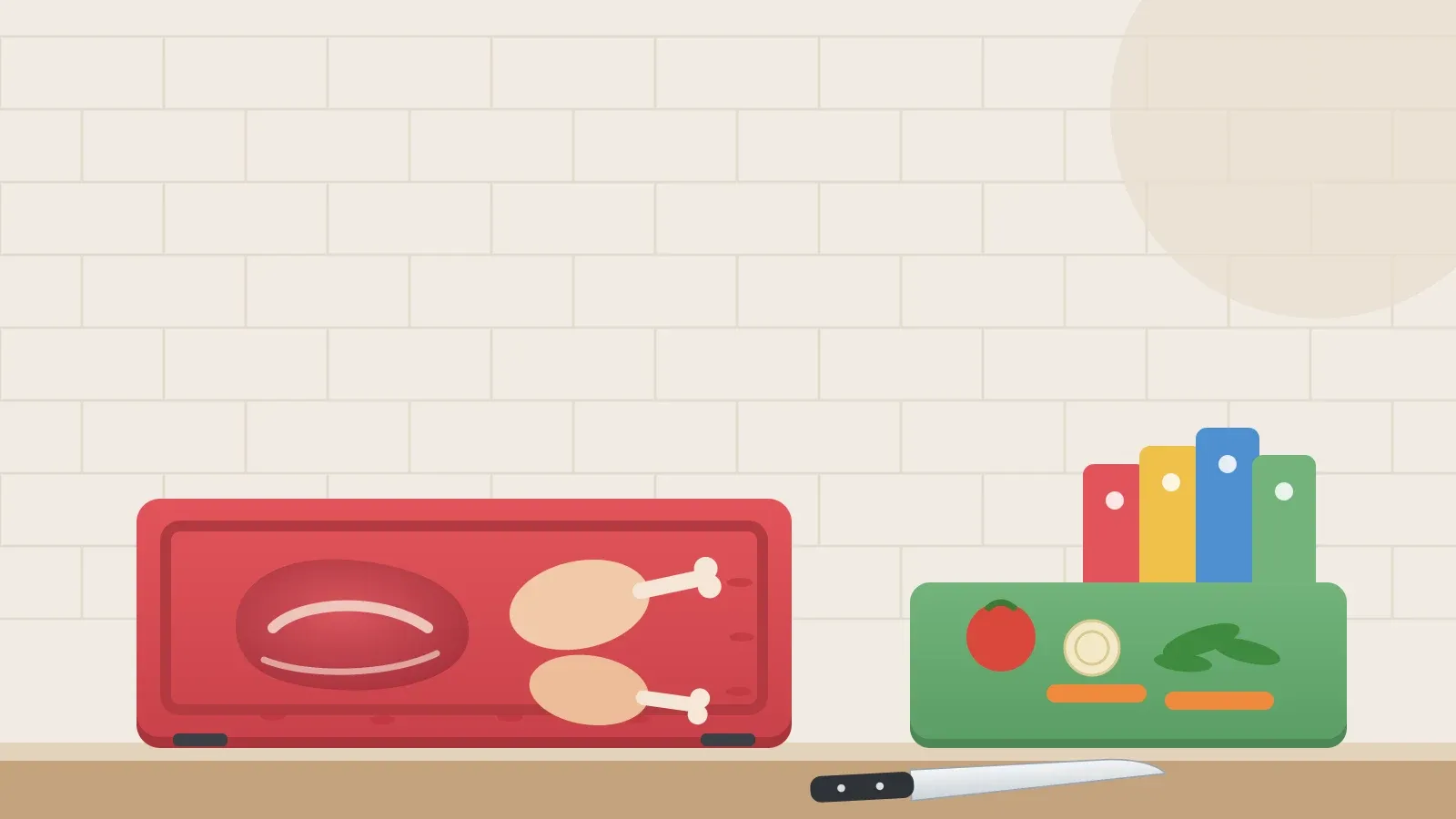
Then color-code. Red for raw meat is a common commercial convention, and it means nobody has to remember which white board touched the chicken.
How to clean a raw meat cutting board, step by step
Even the best cutting board for raw meat is only as safe as the way you clean it. University extension services publish the same routine, based on USDA guidance:
-
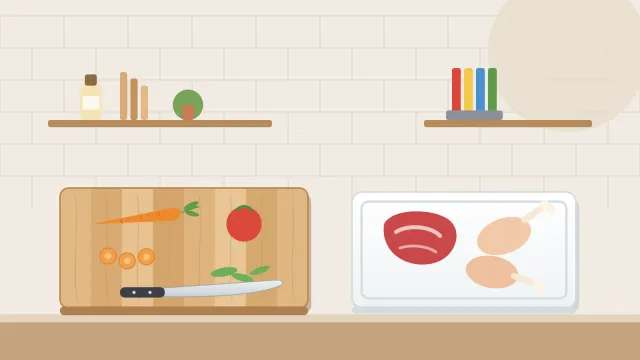
Use it only for raw meat, poultry and seafood. Keep a separate board for produce, bread and cooked food. If you only have one board, cut the vegetables first, then the meat, then wash it.
-
Wash it right away. Scrub it in hot, soapy water and rinse, or run it through the dishwasher if it’s dishwasher safe. Don’t leave it in the sink while you eat.
-
Sanitize it now and then. The Wisconsin extension recommends a solution of 1 tablespoon of unscented liquid chlorine bleach per gallon of water. Flood the surface, let it stand for several minutes, then rinse it and let it air dry. (University of Wisconsin–Madison Extension)
-
Dry it standing up. A board lying flat on a wet counter stays damp underneath. Stand it in a dish rack until both sides are dry.
-
Replace it when it’s scarred. As the University of Illinois Extension puts it, once a board has many cut marks and deep grooves, it’s time for a new one.
Wood vs plastic cutting boards for raw meat: what the research says
There’s no clean winner in the research. The USDA says either wood or a non-porous surface can work. Some studies have found fewer bacteria on used wood than on used plastic, because wood pulls moisture into its fibers. On the other hand, plastic can go through a hot dishwasher, which wood can’t.
Plastic has a newer question mark, too. A 2023 study in Environmental Science & Technology found that chopping on plastic boards releases microplastics into food, and that polypropylene boards shed more than polyethylene ones (Yadav et al., 2023). The health effects are still unknown, and the authors called their toxicity tests preliminary.
So our take is practical. For raw meat, we’d still choose a non-porous board you can wash hot, and we’d replace it before it gets shaggy, since a scarred board sheds more and hides more bacteria. For everything else, a wooden board is lovely to cut on. Our wood vs plastic cutting board guide compares the two materials in full.
Where to keep a raw meat board in a small kitchen
A board that lives at the back of a cupboard gets swapped for whatever is closest, and that’s how raw chicken ends up on the bread board. So give it a fixed, easy spot:
- Stand it upright in a pan organizer or file rack next to your other boards, with the raw meat board on the outside. Our small kitchen organization guide has more ideas for storing boards vertically.
- Use the inside of a cabinet door with a slim rack, as we suggest in our guide to organizing a kitchen without a pantry.
- Never store it wet or stacked flat against another board.
A good board also pairs with the right knife. If you’re still choosing one, start with our guide to the types of kitchen knives. And if you portion meat from bulk packs, our vacuum sealer guide shows how to freeze it in meal-size bags.
FAQ
What is the best cutting board for raw meat?
A plastic board you use only for raw meat and can put in the dishwasher. Our top pick is the OXO Good Grips Plastic Utility Cutting Board. If you cut whole birds or roasts, add a larger board with a juice groove.
Can you use a wooden cutting board for raw meat?
Yes, if you wash and sanitize it well, and the USDA allows it. Even so, wood can’t go in the dishwasher and needs oiling, so most cooks keep a plastic or rubber board for raw meat and use wood for everything else.
What color cutting board is for raw meat?
In many commercial kitchens, red marks the raw meat board. Other common codes are yellow for raw poultry, blue for fish, green for produce and white for bread and dairy. At home, any system works as long as everyone knows it.
How often should you replace a plastic cutting board?
When the grooves are deep enough to catch a fingernail, or when stains and smells don’t wash out. For a board that sees raw meat several times a week, that’s often every one to two years.
Should raw chicken and raw beef have separate boards?
Ideally, yes: the University of Illinois Extension suggests separate boards for red meat, poultry and seafood. If you only have room for one raw board, the bigger win is keeping all raw meat away from food you won’t cook, like salad, bread and fruit.
Is it safe to cut vegetables on a board after raw meat?
Only after you wash it in hot, soapy water. Better still, cut the vegetables first, or use a second board.
Do plastic cutting boards hold bacteria?
New ones clean up well. Deep knife grooves are the problem, because they can hide bacteria that a sponge can’t reach. That’s why plastic boards need replacing once they’re heavily scarred.
New to knives? Start with our complete guide: Types of Kitchen Knives and Their Uses: The Complete Guide