Small Pantry Organization: Ideas and Organizers That Fit
Small pantry organization in 10 steps: measure first, zone the shelves, add risers, turntables and labeled bins, use the door, and keep it tidy all year.
PulseCrafted Kitchen is reader-supported: when you buy through links on this page, we may earn a commission at no cost to you. As an Amazon Associate I earn from qualifying purchases. How we make money
On this page
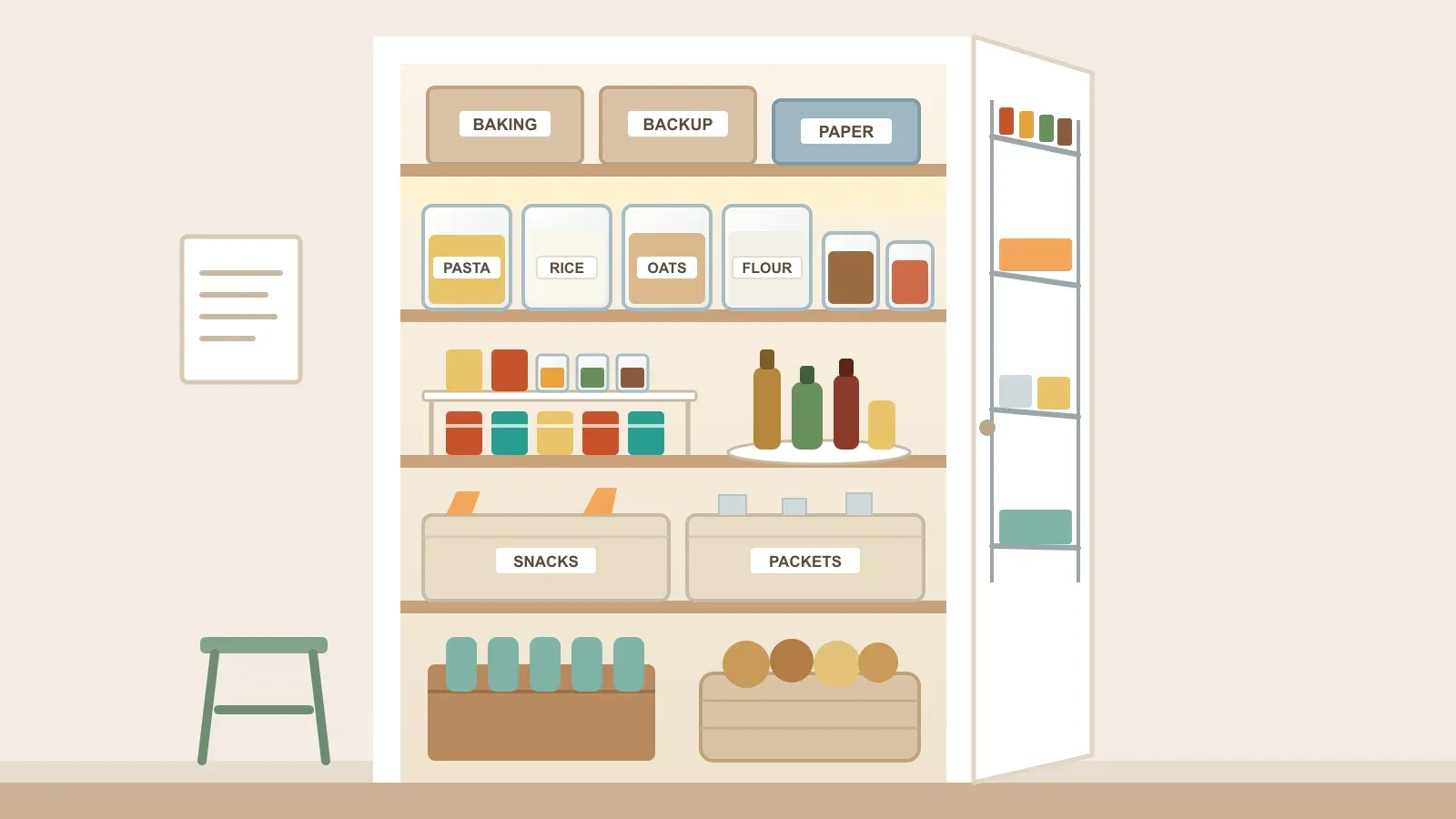
Small pantry organization comes down to three things: keep less in it, give every shelf a job, and use the height you’re wasting. Empty the pantry, sort the food into groups, and measure each shelf before you buy a single organizer. Then put everyday food at eye level and double short shelves with risers. Turntables rescue the corners, labeled bins corral loose packets, and the door holds the rest. Most reach-in pantries take an afternoon.
A small pantry rarely runs out of space because it’s too small. It runs out because half of each shelf is air above short cans, and the back corners hold food nobody can see. The ten steps below fix that, roughly in the order a professional organizer would work.
How we put this together: we used food storage advice from the USDA and university extension services. The methods come from our small kitchen organization ideas guide. We haven’t tested the organizers in our own pantry. Instead, we compared their sizes, weight limits and materials against typical small pantry shelves, and read owner feedback for common problems. (More on how we choose what to recommend.) Short on time? Jump to our six organizer picks.
Time: two to four hours for a reach-in pantry, plus a shopping trip once you’ve measured.
Small pantry organization, step by step
1. Empty it and check the dates
First, take everything out and wipe the shelves. Throw out anything past its date, and look for pests while the shelves are bare: webbing, tiny moths or holes in packets. Clemson University’s Home and Garden Information Center calls good sanitation the best prevention for pantry moths. A clean start matters more than any organizer.
2. Sort food into groups
Group what’s left the way a grocery store would: breakfast, baking, grains and pasta, cans and jars, snacks, oils and sauces, spices, drinks. Put duplicates together. Now decide what really needs pantry space. Bulk packs and backups can live on the top shelf, in another closet or in the freezer. The pantry then holds only what you use.
3. Measure every shelf
Write down the width, depth and height between each pair of shelves. Measure the inside of the door and the space above the top shelf too. Note anything in the way, such as a light switch or the door frame. Measuring first is what stops you from buying bins that are an inch too deep for the door to close.
4. Give each shelf a job
Store food by how often you reach for it. The shelves between eye and hip height hold what you use every day. The top shelf takes backups and things you need a few times a year. Heavy items, like bottled drinks, potatoes and bulk rice, go low or on the floor, where they’re safe to lift. Keep each group from step 2 together, so everyone in the house knows where things go back.
5. Double short shelves with risers
Most pantry shelves are spaced for cereal boxes, which leaves a gap above cans and jars. A shelf riser or a stacking shelf adds a second level in that gap: cans below, spice jars or small boxes on top. Tiered can risers do the same thing from front to back, so every label stays visible.
6. Spin the corners with turntables
Corners and the back of deep shelves are where food disappears. A turntable brings the back to the front with one spin, which makes it ideal for oils, vinegars, sauces and jars. Measure the shelf depth first: a turntable about 2 inches smaller than the depth turns freely.
7. Decant staples into square containers
Flour, sugar, rice, pasta, oats and snacks take less space in clear, square containers than in their bags and boxes. Square shapes sit edge to edge, stack, and show you when you’re running low. Airtight lids help too: Clemson recommends insect-proof containers with tight-fitting lids for dry goods. Glass lasts for years, but light plastic is fine for dry food; our glass vs plastic food storage comparison explains the trade-offs.
8. Corral loose packets in labeled bins
Seasoning packets, snack bags, tea and drink mixes slide around and spill. Give each group an open bin and label the front. Then you pull out one bin, take what you need and slide it back. On deep shelves, choose bins about an inch shallower than the shelf, and they work like drawers.
9. Use the back of the door
An over-the-door rack holds spices, small jars, snack bags and wraps one row deep, so nothing hides. Before you buy one, check that the door still closes with the rack loaded and that the hooks fit the door’s thickness. No door, or a sliding one? In that case, mount slim racks on the side walls of the pantry instead.
10. Light it and keep it tidy
Small pantries are often dark, and you can’t use what you can’t see. A battery-powered LED light or strip under the top shelf needs no wiring. After that, a simple routine keeps it working. Put new food behind the old and keep a shopping list on the door. Once a month, spend ten minutes putting strays back. That habit is what keeps small pantry organization working long after the first weekend.
Small pantry organizers that fit
Good small pantry organization is mostly about matching each organizer to its shelf. Here’s what each type is good for and what to measure first.
| Organizer | Best for | Measure first |
|---|---|---|
| Shelf riser or stacking shelf | Cans, jars and small boxes on tall shelves | Height between shelves and shelf width |
| Turntable | Oils, sauces and jars in corners | Shelf depth (about 2 in more than the turntable) |
| Clear, square containers | Flour, rice, pasta, oats, snacks | Shelf height, with room to lift the lid |
| Open bins and baskets | Packets, snacks, tea, potatoes and onions | Shelf depth, minus an inch for the door |
| Over-the-door rack | Spices, jars, snack bags, wraps | Door thickness and clearance when closed |
| Tiered can riser | Canned goods you want to see at a glance | Shelf depth and the height of your tallest can |
Our 6 picks for small pantry organization
These six organizers each do one of the jobs above, and all of them fit a typical reach-in pantry. Start with the one that fixes your biggest problem: wasted height, lost corners or loose packets.
- Best shelf riserSimple Houseware Expandable Stackable Shelf Organizer, 2-PackCheck price
- Best for canned goodsYouCopia ShelfSteps Can OrganizerCheck price
- Best turntableCopco Non-Skid Lazy Susan Turntable, 12-InchCheck price
- Best containersOXO Good Grips 10-Piece POP Container SetCheck price
- Best binsClearSpace Clear Plastic Pantry Bins, 4-PackCheck price
- Best door rackSmart Design Over-the-Door Pantry Organizer, 6 BasketsCheck price
| Start here | Canned goods | Corners | Dry goods | Packets | The door | |
| Product | Simple Houseware Shelf | YouCopia ShelfSteps | Copco Turntable | OXO POP Set | ClearSpace Bins | Smart Design Door Rack |
| Best for | Doubling short shelves | Cans you want to see | Oils, sauces and jars | Flour, rice, pasta, snacks | Packets, snacks, tea | Spices, jars, snack bags |
| Size | 12.75 x 9 x 5.9 in and 11.25 x 7.9 x 5.4 in | 13.4 in wide, 4.8 to 12.6 in deep, 6.5 in tall | 12 in across | Ten square sizes | 11 x 8 x 6 in, each | 17 x 7.25 x 59 in |
| Capacity | Up to 30 lb per shelf | 16 to 24 cans | Up to 5 lb | 0.4 to 4.4 qt each | 4 stackable bins | 10 to 25 lb per basket |
| Material | Powder-coated steel | Plastic | Plastic with a nonskid liner | BPA-free plastic | BPA-free plastic | Steel wire |
| Measure first | Height between shelves | Shelf depth; not for wire shelves | Shelf depth, about 14 in | Shelf height for the tall ones | Shelf depth, 12 in or more | Clearance when the door closes |
| Buy | Check price on Amazon | Check price on Amazon | Check price on Amazon | Check price on Amazon | Check price on Amazon | Check price on Amazon |
Simple Houseware Expandable Stackable Shelf Organizer, 2-Pack
Best for: Shelves where cans and jars leave a gap of air above them
This is the simplest way to add a second level to a short shelf. Put cans or jars underneath and lighter things on top, like spice jars, tea or small boxes. You get two sizes, so you can fill a wide shelf or split them between two. Measure the height under each one first, since the legs don’t adjust.
What we like
- Two sizes that sit side by side, overlap or stack
- Steel shelves rated for up to 30 lb each
- Shallow enough for 12-inch pantry shelves
- Works for cans below and spices or small boxes on top
Watch out for
- Fixed height: check your tallest cans fit underneath
- Only 9 inches deep, so deep shelves need something behind it
- Some assembly needed
- Large
- 12.75 in wide, 9 in deep, 5.9 in tall
- Small
- 11.25 in wide, 7.9 in deep, 5.4 in tall
- Material
- Powder-coated steel
YouCopia ShelfSteps Can Organizer
Best for: Small pantries where a big rolling can rack won't fit
Rolling can racks hold more, but a popular 36-can model needs about 17.5 inches of width and a 12-inch-deep shelf. This stepped organizer is smaller and slides in or out to match the shelf depth. You can also split the three steps up and use them on different shelves. It keeps cans in view, which helps you use the old ones first.
What we like
- Three tiers, each 2.25 inches higher, so every label shows
- Depth expands from 4.8 to 12.6 inches to fit the shelf
- Holds 16 to 24 cans and up to 30 lb
- Soft non-slip feet
Watch out for
- Not made for wire shelves
- Holds fewer cans than a rolling can rack
- Plastic, not metal
- Size
- 13.4 in wide, 6.5 in tall
- Depth
- 4.8 to 12.6 in
- Material
- Plastic
Copco Non-Skid Lazy Susan Turntable, 12-Inch
Best for: Back corners and deep shelves where bottles get lost
A turntable turns a dark corner into the front of the shelf. Put oils, vinegars, sauces and jars on it, and one spin brings the back row to you. The 12-inch size suits most pantry shelves. If yours are only about 12 inches deep, Copco also makes a smaller 9-inch version.
What we like
- Nonskid liner stops bottles sliding as it spins
- Raised rim keeps things from falling off
- Light and easy to wipe clean
- Spins smoothly with one hand
Watch out for
- Recommended for up to 5 lb, so not for heavy stacks of cans
- One level only
- Needs a shelf about 14 inches deep to turn freely
- Diameter
- 12 in
- Max load
- 5 lb
- Material
- Plastic with a nonskid liner
OXO Good Grips 10-Piece POP Container Set
Best for: Decanting flour, sugar, rice, pasta, cereal and snacks
Clear, square containers are what make a small pantry look calm, and they fit more food on a shelf than bags and boxes do. The POP lids seal with one press, so they’re easy to use every day. The airtight seal also helps keep pantry pests out. Buy them for food that comes in bags; cans and jars don’t need decanting.
What we like
- Push-button lids seal airtight and double as a handle
- Square shapes stack and sit edge to edge
- Ten sizes, from 0.4 to 4.4 quarts
- BPA-free and top-rack dishwasher safe
Watch out for
- A bigger investment than basic canisters
- Check shelf height before you buy the tallest sizes
- Plastic, so it can scratch over time
- Contents
- 10 containers, 0.4 to 4.4 qt
- Lids
- Push-button airtight seal
- Material
- BPA-free plastic
ClearSpace Clear Plastic Pantry Bins, 4-Pack
Best for: Seasoning packets, snack bags, tea and drink mixes
Bins are the fix for the little things that slide around and spill. Give each group its own bin, add a label on the front, and pull the whole bin out when you need something. At 11 inches long, they fill a typical pantry shelf front to back. That’s why nothing gets pushed out of sight.
What we like
- Clear sides show what is inside
- Built-in handles make them work like drawers
- Stackable
- BPA-free, shatter-resistant plastic
Watch out for
- 11 inches long, so they need a shelf about 12 inches deep
- No lids
- Sized for packets and snacks, not tall bottles
- Size
- 11 x 8 x 6 in, each
- Contents
- 4 bins
- Material
- BPA- and chlorine-free plastic
Smart Design Over-the-Door Pantry Organizer, 6 Baskets
Best for: Spices, small jars, snack bags and wraps, one row deep
The back of the door is the biggest empty space in most small pantries. This rack turns it into six shallow shelves, so spices and snacks sit one row deep where you can see them. Before you order, measure from the door to the front of the shelves with the door closed. No door, or a sliding one? The included hardware lets you mount it on a wall.
What we like
- Six adjustable baskets: three large, three medium
- Large baskets hold 25 lb, the others 10 lb
- Hooks fit most home doors, with no drilling
- Hardware included to mount it on a wall instead
Watch out for
- Adds about 7.25 inches to the door, so check it clears the shelves
- At 59 inches tall, it needs a full-height door
- Wire baskets let tiny items slip through
- Size
- 17 in wide, 7.25 in deep, 59 in tall
- Baskets
- 3 large, 3 medium
- Material
- Steel
Ideas for different small pantries
- Reach-in closet pantry: use all the steps above, and keep the floor for drinks and a produce basket.
- Cabinet pantry: pull-out bins work best on deep cabinet shelves, and a door rack holds spices.
- Deep pantry with dark corners: turntables in the corners, and bins that pull out like drawers.
- No pantry at all: see our guide to turning a kitchen cabinet into a pantry.
Wherever your pantry is, keep it away from heat and damp. The USDA’s advice on shelf-stable food is to store it in a cool, dry place, away from the stove and the sink.
Mistakes to avoid in small pantry organization
- Buying organizers before you measure. Bins that are too deep stop the door from closing.
- Decanting everything. Cans and jars already stack well; save containers for bags and boxes.
- Filling every inch. A little empty space makes it easy to put things back.
- Hiding food in the back. If you can’t see it, you’ll buy it again.
- Keeping bulk packs in a small pantry. Store backups elsewhere and refill from them.
FAQ
How do you organize a small pantry with deep shelves?
Use bins about an inch shallower than the shelf as pull-out drawers, and put turntables in the corners. Keep tall items at the back and short ones in front. That way nothing gets lost behind something else.
What should go on each shelf of a small pantry?
Everyday food goes between eye and hip height. Backups and rarely used items go on the top shelf. Heavy things like drinks, potatoes and bulk rice go low or on the floor.
How do I make my small pantry look organized on a budget?
Remove bulky packaging, group food by type, face labels forward and use matching bins or jars only where they help. Reused glass jars and shoebox dividers work until you know which organizers you really need.
How do you keep pantry moths out?
Keep shelves clean, buy packages that are sealed and undamaged, and store dry goods in containers with tight-fitting lids. Those are the prevention steps Clemson’s extension service recommends.
What are the best organizers for a small pantry?
The best ones fix your biggest problem. Shelf risers and a stepped can organizer use the wasted height. A turntable rescues the corners, clear bins corral loose packets, and a door rack adds storage without taking shelf space. Our six picks above cover each job.
Should I decant everything into containers?
No. Decant food that comes in bags or awkward boxes, such as flour, rice, pasta and snacks. Cans, jars and spice jars already stack well, and decanting them only adds work.
For more storage help, see our small kitchen organization ideas, our best under kitchen sink organizer guide, or every guide in the Storage & Organization category.
New to storage? Start with our complete guide: Small Kitchen Organization and Storage Ideas: The Complete Guide